The beautiful part about the world is that it’s extremely diverse. Weird things that are socially unacceptable in one country could be considered beautiful in another.
Physical defects are one of the weird things that some countries consider beautiful. If you have crooked teeth, in some countries you’d be a hot commodity. Do you have really pale skin? Not to worry, there is one country that would love to have you.
Below you will find the top weird things that are considered sexy in various countries.
Scars: In certain African countries like New Guinea, they still decorate their bodies and faces with artistic scars. These scars are usually used to mark milestones for men and women such as puberty and marriage.
veleknez/shutterstock.com
Overweight: In Mauritania, which is in Northwest Africa, if a woman wants to get noticed by a man, she must have a lot of folds on her stomach. In order to make sure they gain the proper weight; families send them to farms where they eat up to 16,000 calories a day, according to Lindsey A. Guerrero, who has spoken about the force-feeding of these young girls.
http://mac.h-cdn.co
Crooked Teeth: A perfect smile in western civilization is a perfectly straight line of teeth. In Japan, perfect teeth are not straight, they’re crooked. Dentists are in high demand for those who want this look.
http://i.dailymail.co.uk
Pale Skin: In various parts of Asia, pale skin is beautiful. When the temperature is hot and the sun is shining, many people will wear masks when they go to the beach to protect their pale skin.
TonyV3112/shutterstock.com
High Foreheads: In the medieval times, women often removed half their hair on the top of their head to have high foreheads. The same custom is done by women in the Fula tribe in Africa.
https://c1.staticflickr.com
Surgical Dressing on the Nose: Some people get rhinoplasty to fix a deformed part of their nose. In Iran, people line up for this procedure to get the dressing put on their nose.
http://exploreplasticsurgery.com
Red Skin & Stretched Lips: In Ethiopia, there is a tribe called the Mursi. The girls stretch their lips with large disks. The larger the disk, the better her social status becomes. The Himba, who live in northwest Namibia, cover their body in red ochre and fat to protect their body from the sun.
Monobrow: In certain areas of Tajikistan, the monobrow is considered a sign of beauty. The locals believe that a monobrow is an indication that a person will be very fortunate in life.
Language is something that we generally take for granted. We seldom wait to think about the origins of the words that we use in our daily conversations or the reason why we use certain words and the phrases the way we do. The world houses thousands of languages that all have interesting attributes and facts behind them. We bring to you 12 of the coolest linguistic facts from languages around the world.
1. Pirahã is a Brazilian language that can be whistled, hummed, or encoded in music.
The Amazonian rainforests house a tribe of indigenous people known as the Pirahã. Their language, Pirahã, is one of the last surviving dialects of the Mura language, the language of the state of Amazonas, Brazil. Even though the language is one of the simplest languages phonologically, there are certain things about the language that would just blow your mind.
The Pirahã language contains one of the smallest phoneme inventories which means that there are very few sound variations in the language. The language also does not contain any words to refer to colors. It just has two words for light and dark.
Another unique feature of the language is that it can be hummed and whistled and can be understood without the use of any physical words. Moreover, according to Daniel Everett a researcher working on the language, vowels and consonants can be removed entirely from the language, and yet the meaning can be communicated to other people through variations in pitch, rhythm, and stress. The tone you use determines the meaning that you wish to convey! The Pirahã mothers have been known to teach the language to the kids by singing the same tunes over and over again.(source)
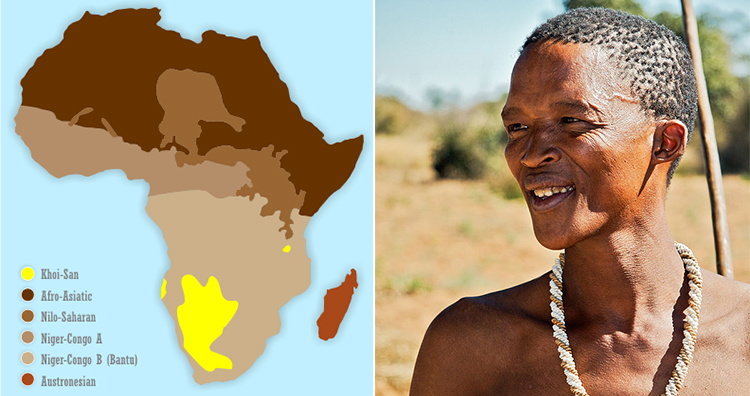
2. There is a language in Africa that only uses five distinct clicking sounds to make up the entire language.
Africa has a number of languages that just consist of click sounds! Known as Khoisan languages, clicks function as normal consonants in these languages. Clicks are distinctive sounds that are made in the mouth via a suction mechanism. This leads to a sharp popping or smacking sound when the tongue touches the roof of the mouth.
Most of these languages consist of just four clicking sounds that can be used to represent the majority of the consonants. Some southern languages use a fifth click, the kiss sound.
Clicks are the initial sounds in about 70% of the words that are part of the Khoisan vocabulary. They offer a bit of dramatic effect during conversations. The uniqueness of these languages has given rise to speculations that maybe the sounds have some kind of special meanings attached to them. But experts believe that that is not the case.(source)
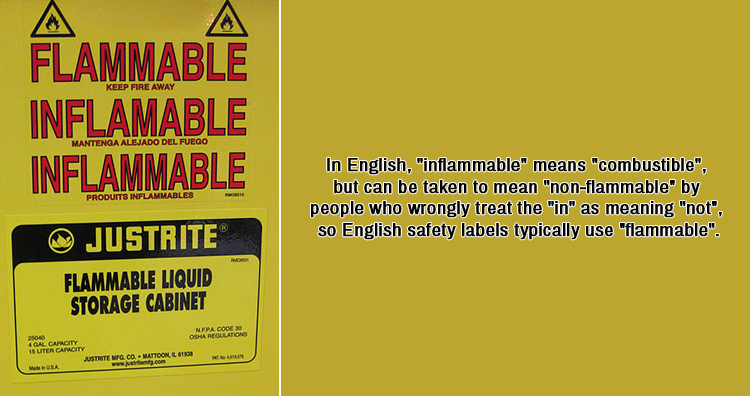
3. The English language consists of words, known as contronyms, that are their own opposites. For example, the word “cleave” has two meanings, i.e. “to cut apart” and “to bind together” which are opposites of each other.
“Contronym” is a word that has multiple meanings in which two of the meanings are completely opposite of each other. Such words are also known as “autantonyms” or “contranyms.” The English language has numerous examples of contronyms. The contronyms might have originated when two different words with different etymologies converged to form a single word or when a single word acquired different and opposite meanings over a span of time. Some contronyms that are commonly used in the English language include “dust“ (verb) which stands for both “to remove dust” and “to sprinkle with soil or dust;” “enjoin” (verb) which stands for both “to prescribe” and “to forbid;” and “ravel” (verb) which stands for both “to tangle” and “to disentangle” threads or fibers.
Apart from English, contronyms can be found in other languages as well. In Latin, “sacer” stands for both “sacred” as well as “accursed.” Also, the Romanian verb a “închiria” means “to rent” as well as “to let.”(source)
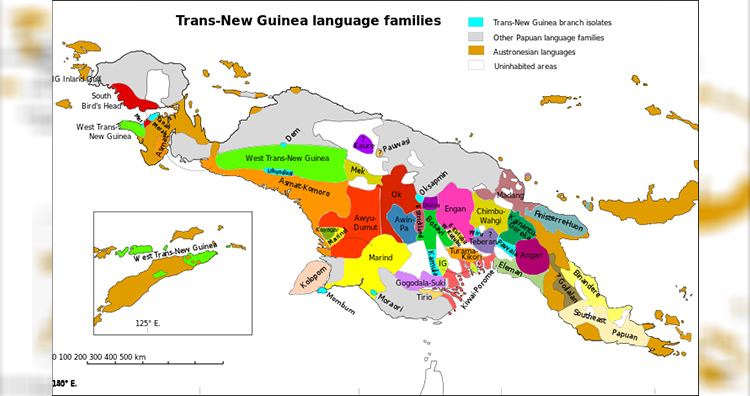
4. Papua New Guinea has over 850 living languages.
Papua New Guinea has over 850 languages that are spoken by the tribes residing there. Mind it, these are not dialects. These are whole languages making Papua New Guinea the most linguistically diverse place on earth. They even have a sign language, Papua New Guinean Sign Language, as one of the four official languages with the other three being Tok Pisin, English, and Hiri Motu. Even though English is an official language, it is spoken by only 1–2% of the population.(source)
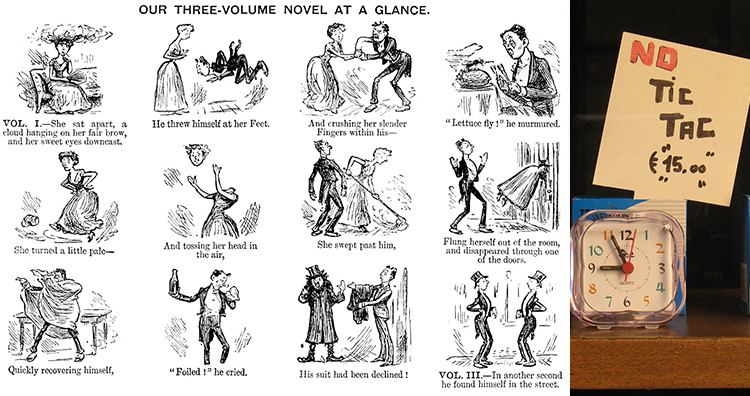
5. The word “cliché” was originally an onomatopoeia. It came from the sound that old printing presses made while making copies.
“Onomatopoeia” refers to words that describe or mimic the sound that it describes. For example, the sound of a clock can be expressed as “tick-tock” in English. The origin of the word “cliché” was also onomatopoeic.
“Cliché” originated from the French language. The word was used in reference to printing where it referred to a block that reproduced words or images that would be used repeatedly later during printing. It originated from the clicking sound that the printing machine made while making copies.(source)
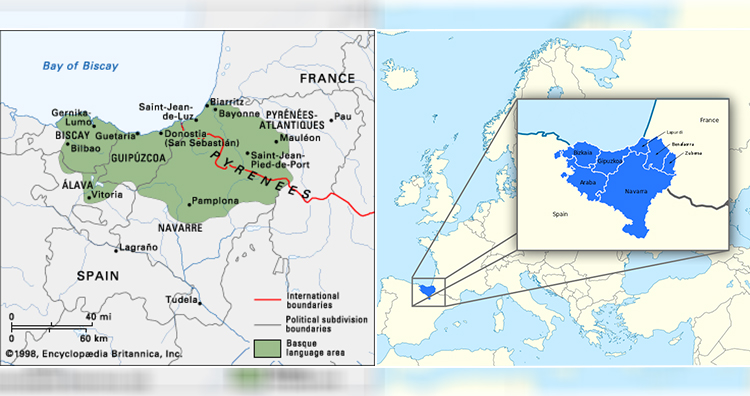
6. Basque is a language isolate. This means that the language is not related to any other known living language even though it is spoken in the region between France and Spain.
Basque is a language native to the people who reside in the Basque country, a region that lies between the borders of France and Spain on the Atlantic coast. What’s unique about the language is that linguistically, Basque is not related to any language of Europe nor to any other known living language that exists in the world.
Basque is the last remaining language among numerous languages that were spoken in southwestern Europe before the region was Romanized in the 2nd century BCE. According to some statistics, Basque speakers can be found in other parts of Europe as well as the Americas. These speakers are majorly bilingual and are said to be approaching a million in the 21st century.(source)
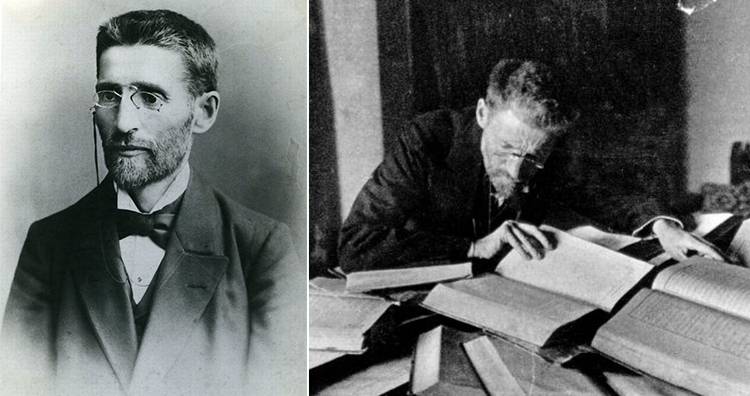
7. Hebrew died as a spoken, native language around 200 CE. It was later revived on 13 October 1881 in Paris when a man named Eliezer Ben-Yehuda and his friends agreed to exclusively speak Hebrew in their conversations.
The Biblical language Hebrew was spoken some 3,000-3,500 years ago. Once upon a time, it was a language spoken by many. But after the Bar Kohba War of 135 CE, Hebrew slowly started declining as a native, spoken language, even though it was still used for writing for many centuries thereafter.
It was on October 13th, 1881 that the language was once again revived by a group of friends. Eliezer Ben-Yehuda and his friends made a pact to only converse in Hebrew. The credit goes to Eliezer for reviving the language after so many years. Eliezer started learning Hebrew when he was just three years old. When Jewish nationalism gained popularity in 19th century Europe, Eliezer became fascinated with Zionism. He also became acquainted with the concept that speaking a common language is a criterion to define a nation worthy of national rights. This gave Eliezer the idea that reviving the Hebrew language would help to unify Jews worldwide.
Eliezer has had a major contribution to the establishment of the Committee of the Hebrew Language which later became the Academy of the Hebrew Language. He also wrote the first Modern Hebrew dictionary.
As of today, Hebrew is spoken by more than 5 million people as their native language and is the national language of the State of Israel.(source)
8. Mbabaram is an extinct Australian language in which the word for dog is “dog.” There is no relation between these words, and this is a pure coincidence.
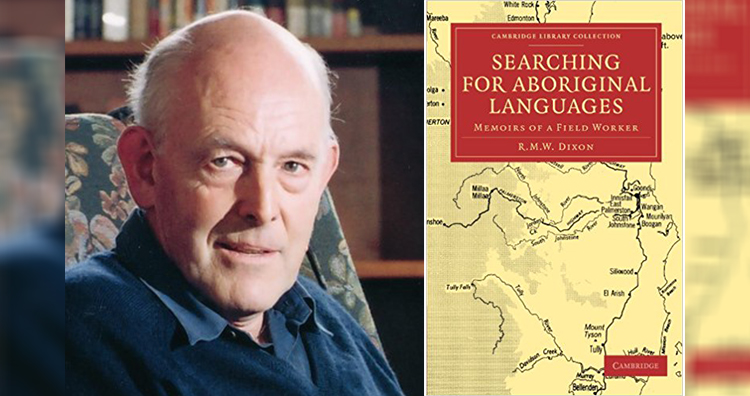
Prof R. M. W. Dixon, Book Cover – Searching for Aboriginal Languages – Memoirs of a Field Worker. Image source: research.jcu.edu.au, amazon.com
Mbabaram was the traditional language of the Mbabaram tribe and is an extinct Australian Aboriginal language. The language is quite famous in linguistic circles because of a striking similarity that it has with an English word.
R. M. W. Dixon, author for Searching for Aboriginal Languages: Memoirs of a Field Worker and a researcher of the language, began studying the language by extracting a few nouns. One of the nouns was the word for “dog.” He discovered that the Mbabaram word for dog was in fact “dog,” and it was pronounced almost identical to the English word. But this is a pure coincidence. There is no relationship between the two languages.(source)
9. Before the English-speaking community was introduced to the fruit, the color orange was referred to as “geoluhread” which stood for red-yellow in Old English.
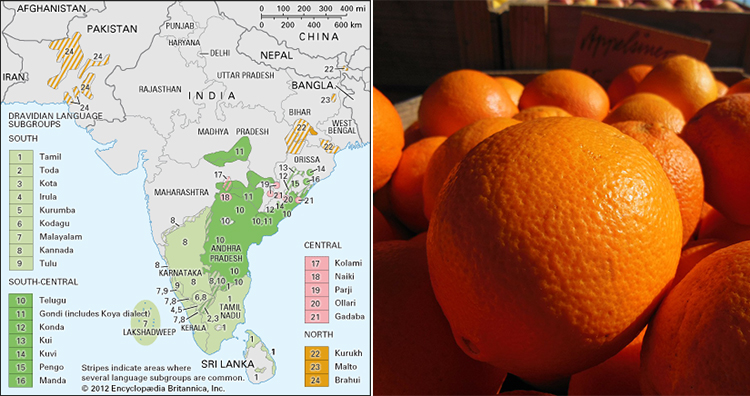
There was no orange color in English before the English-speaking people came to know of the existence of the fruit orange. The word is known to be a derivative of a Dravidian language, possibly Tamil, and it was passed through numerous other languages such as Sanskrit and Old French. Finally, it reached the English language. The earliest recorded use of the word “orange” in English was in the 13th century when it referred to the fruit. It was only in the 16th century that the word was used to refer to the color.
Before the fruit was introduced to English speakers, the color orange was known as “geoluhread.” It meant red-yellow in Old English.(source)
10. People who communicate via American Sign Language can have accents just as they would in a spoken language.
A research at the University of Pennsylvania discovered that people who converse via American Sign Language (ASL) have an accent of their own similar to people who speak the language. There was a comparison made between the ASL used by people in Philadelphia and the standard ASL. It was found that many of the words were exceptionally different when compared with standard ASL guidelines. The Philadelphia sign language was found to resemble French more than standard ASL.
People who use sign language have accents that vary depending on their age, ethnicity, and whether they are able to somewhat hear or are completely deaf. It has also been observed that the speed in which they deliver the conversation also differs. People using sign language in New York are fast talkers whereas those in Ohio were slow and relaxed. Moreover, people belonging to the southern states of United States tend to touch their lower face and chest when they communicate with sign language, and that has become a distinct regional accent.(source)
11. The English language has an order in which adjectives go and it sounds wrong if the adjectives are not in that order. For example: “loose red top” vs. “red loose top.”
Image credits: Pixabay, Pixabay
Let’s say it is a warm sunny day and you were roaming outside with your friends wearing a red loose top. Does the sentence sound wrong to you? Should it be “loose red top” instead of “red loose top?” It should be, shouldn’t it?
There is a code that governs the order in which English speakers use adjectives in their sentences. Nobody is taught the order. It is mostly based on the intuition that makes the sentence sound wrong if the adjectives are used in the wrong order.
Such problems generally arise when the border between adjectives for size and color disappears. Linguists have determined a code for such instances that goes as follows: general opinion, then specific opinion, then size, then shape, then age, then color, then provenance, then material (GSSSACPM). Studies have shown and confirmed that GSSSACPM is consistent in most of the instances of written English. In 2003, Stephanie Wulff used a computer program to go through thousands of texts and found out that 78% of the strings of adjectives followed the GSSSACPM code.
So, now, you decide whether this is a cool informative fact or an informative cool fact?(source)
12. The word “plumbing” originates from the Latin word for lead, “plumbum,” which is what most pipes were made of at the time.
The concept of plumbing has been prevalent since the ancient Roman, Greek, Indian, Persian, and Chinese civilizations. These civilizations had public baths and they needed to offer flowing water and wastewater removal systems in the baths. They used pipes that were made of lead.
The scientific name for the element lead is plumbum and its symbol is Pb. This is where the word “plumbing” came from. The word “plumber” also originated during this time.(source)
Pictures speak a thousand words. Yes, that’s true. But there are a few pictures that can actually leave you speechless. Some such photos capture the last moments before something terrible happens. And you would be amazed to see how unintentional and accidental these photos are. We bring to you 12 such photos taken right before something bad happened.
1. Photo taken split seconds before PSA 182 collided with a private airline and killed all 135 people on board and seven on the ground.
On Monday, the morning of 25 September 1978, a Boeing 727-214 commercial airplane, PSA flight 182, collided mid-air with a private aircraft, a Cessna 172. It became one of the deadliest aircraft disasters in California with a death toll of 144.
PSA 182 had 135 passengers on board, and the crash also killed seven people on the ground including two children. Both the pilots of the private aircraft were killed on impact. Nine people on the ground were injured severely, and 22 homes were destroyed or damaged.
The reason for the crash was the pilots of PSA182 were unable to see the private aircraft as it was just below them, and it’s color blended with the color of the houses below. The collision happened at about 2,600 feet from the ground.
The picture above was taken by photographer Hans Wendt of the San Diego County Public Relations Office who was attending an outdoor event. He was able to capture two photographs of the aircraft after the collision, with one depicting its right wing burning. The San Diego Union-Tribune was awarded a Pulitzer Prize in 1979 for its coverage of the crash.(source)
2. On 28 January 1986, the space shuttle Challenger exploded during its flight killing all crew members. This photo of the crew, smiling at the camera, was taken just before the explosion.
When the tenth flight of space shuttle Challenger took off, as part of the NASA shuttle orbiter mission, it exploded within 73 seconds of taking off. All seven crew members, including five astronauts and two payload specialists, were killed. The explosion happened because the o-ring seal on the spacecraft’s solid rocket booster failed during take-off. The o-ring was actually not designed for cold temperatures.
The photos above of the crew were taken just before they were about to board the spacecraft.(source)
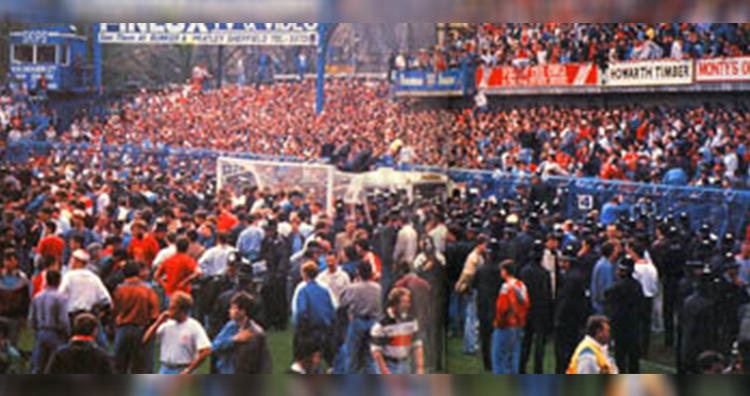
3. Ninety-six football fans lost their lives at the 1989 FA Cup semi-final between Liverpool and Nottingham Forest. This photo was taken when the disaster was just about to happen.
Known as the “Hillsborough Disaster,” the 1989 semi-final game between Liverpool and Nottingham Forest was the site of a disastrous human crush at the stadium. Fatal errors by the management were responsible for the disaster.
It started when hundreds of Liverpool fans stormed towards the stands allocated to them. Seeing the crowd, a standing police officer contacted the control room to delay the game in order to ensure the safety of the fans. The request was declined and more fans kept pouring into the stadium. If that was not enough, David Duckenfield, the police chief in charge of the match, ordered Exit Gate C to be opened. This led to more fans climbing into the stadium which was already overcrowded. With people piling up on the stands, the people who were already in were pushed up hard against the perimeter fencing. Many tried to desperately escape by climbing onto the pens, but many of them were crushed by the massive human force that was building up behind them. In moments, a football field turned into a killing field.
Out of the 96 people who were fatally injured, only 14 of them could make it to the hospital. All 96 of them lost their lives that day, with the youngest one being the 10-year-old Jon-Paul Gilhooley, cousin of Steven Gerrard, who later went on to become Liverpool F.C.’s captain. The photos above depict the last moments of outcry before many succumbed to their deaths.(source)
4. This is a 1942 photo of a woman jumping to her death from the eighth floor of the Genesee Hotel.
On 8 May 1942, Russel Sorgi, a photographer at the Buffalo Courier-Express, was returning home from the office. He decided to take a different route that day. Minutes later, he noticed a police car sweeping right past him. He decided to follow it sensing an opportunity.
He finally reached the Genesee Hotel where a woman was sitting on the edge of the window outside a room on the eighth floor. It looked like she was about to jump. Sorgi recalled, “I snatched my camera from the car and took two quick shots as [Miller] seemed to hesitate . . . As quickly as possible I shoved the exposed film into the case and reached for a fresh holder. I no sooner had pulled the slide out and got set for another shot than she waved to the crowd below and pushed herself into space. Screams and shouts burst from the horrified onlookers as her body plummeted toward the street. I took a firm grip on myself, waited until the woman passed the second or third story, and then shot.” The photo above was the one captured by Sorgi.
Later, the New York Times reported that the woman was Mary Miller who had committed suicide.(source)
5. Rapper Jadiel took this last selfie while riding his motorcycle and uploaded it to Instagram before his death.
Ramon Gonzalez, commonly known as Jadiel, was an American rapper. He gained popularity on songs like Si Tu No Estas Aqui, Fashion Girl, and Sol y Arena. On May 10, 2014, Jadiel was riding his bike when he decided to post a selfie to Instagram. He was wearing his helmet as well his face protector in the photo. Hours later, on the same day, Jadiel lost control of his bike and hit a car going in the opposite direction. The caption of his last Instagram selfie, that you can see above, was “On the road in New York.”(source)
6. This photo was captured moments before a forest fire which came to be known as the “Yarnell Hill Fire.” It took the life of 19 firefighters who were working to contain the fire.
The Yarnell Hill Fire is considered as the third deadliest wildfire, and also the sixth deadliest disaster for firefighters, in the history of US. The fire broke out on 28 June 2013. Two days later, the fire took the lives of 19 firefighters of the 20-man crew. The only survivor was 21-year-old Brendan McDonough who was serving as the lookout during that time.
High-velocity winds and a long-term drought have been identified as the cause for the fast spread of the fire. By 1 July 2013, the fire spread across 8,300 acres, and the nearby areas had to be evacuated. It was only on 10 July 2013 that the fire was declared to be 100% contained.
The photo above was taken just before the fire took the lives of the 19 firefighters.(source)
7. A Filipino politician captured his murderer in this photo before being shot and killed.
A Filipino politician, Reynaldo Dagsa, perfectly captured his murderer just before he was shot and killed. Dagsa was celebrating New Year’s Day with his family and went ahead to take a picture of his wife and kids. Just then, a man shot him in the head. In the picture, it is clearly visible that the man is pointing a gun at Dagsa.
The shooter was identified as Arnel Buenaflor, a member of the Pasaway Gang. Apparently, people associated with Dagsa were involved in a shootout with the gang months earlier. The murder of Dagsa was done for revenge.(source)
8. Andrey Retrovsky accidentally fell from a nine-story building trying to post the perfect Instagram photo. This is what his last photo looked like just before he fell to his death.
Deaths from trying to take the perfect selfie or the perfect photo have haunted the world for quite some time now. But nothing can be more disheartening than the death of a 17-year old boy who lost his life trying to get the perfect picture to post on Instagram.
The above photo is the last photo of Andrey Retrovsky who was trying to get a shot that looked like he was falling from a building. Unfortunately, he actually fell. Even though he was secured with a rope, it was unable to hold him once he started falling.
Reports say that he didn’t die immediately but succumbed to his injuries a few hours later.(source)
9. Robert Overacker was raising awareness for charity by planning to jet ski over Niagara Falls and deploy a parachute to land safely. But somehow, his plan failed, and this picture captured the last seconds of his life before he drowned in the water.
Robert Overacker was a stuntman from California. On October 2, 1995, he planned to jet ski over Niagara Falls, deploy a parachute, and safely land on the other side. He had been planning this stunt for years and attempted twice before but was talked out of it by his family. But on 2 October 1995, he finally decided to go ahead with it.
Overacker had specially designed parachutes with thrusters that were supposed to deploy as soon as he let go of the jet ski. But something went wrong and the parachute didn’t open. Overacker fell to his death in Niagara Falls. Below is a video that captured his stunt:
10. A 14-year-old boy fell to his death on takeoff from Sydney Airport after hiding in a wheel well. An amateur cameraman was testing out his camera when he accidentally captured the fall.
Keith Sapsford, a 14-year-old boy, was hiding on the wheel well of a plane owned by Japanese Airlines. Apparently, he was attempting a stow away on the plane. As the plane took off, Keith was thrown out of the wheel well as the plane changed pitch.
An amateur Australian photographer, John Gilpin, was taking photos of planes taking off when he accidentally got a shot of Keith’s fall. Gilpin didn’t know any of this until he developed his film a week later. The photo was first seen in the Life magazine.(source)
11. A photographer was taking snaps of air pollution on the Wuhan Yangtze River Bridge when his camera lens captured a man committing suicide. Seconds later, a woman jumped in.
An unnamed reporter was working on the Wuhan Yangtze River Bridge taking photos of the air pollution that had been blanketing the bridge when his camera captured something he never expected to shoot. He didn’t realize that when he was concentrating on the settings of his camera, he accidentally captured a man jumping to his death from the bridge.
The reporter later recalled, “To be honest I didn’t even see the first person jump because I was concentrating so much on the camera settings, and I didn’t realize at first that I had snapped the man jumping to his death.” It was only when people started screaming that someone had jumped that the reporter looked up and heard the man hit the waters. Seconds later, a woman jumped from the exact same spot. Above is a photograph taken by the reporter.(source)
12. Paul Walker, moments before his car smashed into a pole and took his life.
None of us can forget the day we got the news that Paul Walker was no more. Moments before his ghastly death, Paul Walker was photographed leaving a charity event with his friend and financial advisor Roger Rodas in a red Porsche. Less than a minute later, their car hit a post and burst into flames claiming the beloved actor’s and his friend’s life. These photos depict his last moments.(source)
Templatesyard is a blogger resources site is a provider of high quality blogger template with premium looking layout and robust design. The main mission of templatesyard is to provide the best quality blogger templates which are professionally designed and perfectlly seo optimized to deliver best result for your blog.








 Hello, my name is Jack Sparrow. I'm a 50 year old self-employed Pirate from the Caribbean.
Socialize