prove: Nature #footer { border-top:1px dotted #999999; clear:both; margin:0 auto; }

Breaking

Home Top Ad

Responsive Ads Here

Post Top Ad

Responsive Ads Here
Showing posts with label Nature. Show all posts

Tuesday, February 20, 2018

The Mysterious case of the Devil’s Kettle Falls where Half a river seems to disappear forever!

At the Devil’s Kettle Falls, the Brule river forks into two. While one part of the river flows normally down to Lake Superior, the other part just vanishes into a deep pit. Now scientists believe they have solved the mystery. 

The Devil’s Kettle Falls is an unusual waterfall located in the Judge C. R. Magney State Park. The falls has a giant, deep hole that swallows half of the Brule River, and, until recently, no one had any idea where that half ended up.


Image Source: Wikipedia, Flickr

The Brule River flows through the Judge C. R. Magney State Park located in Minnesota. It makes a drop of 800 feet in a span of 8 miles creating several waterfalls. Among them lies the mysterious Devil’s Kettle Falls.
About one and a half mile from the Lake Superior, the river forks into two streams at the Devil’s Kettle due to the presence of a protruding rhyolite. While the right part of the river flows down normally and joins the Lake Superior, the left part of the river falls into a giant pit. You can see the pit in the image above.
Now logically, since the water needs to keep flowing, it has to come out somewhere. But for years, people have failed to figure out where exactly the water goes after it falls into the pit — that is until recently.

Over the years, researchers and many curious locals have poured items such as ping pong balls, tree logs, and apparently even a car into the hole and monitored the lake for the objects to emerge. So far, none of the objects have resurfaced.
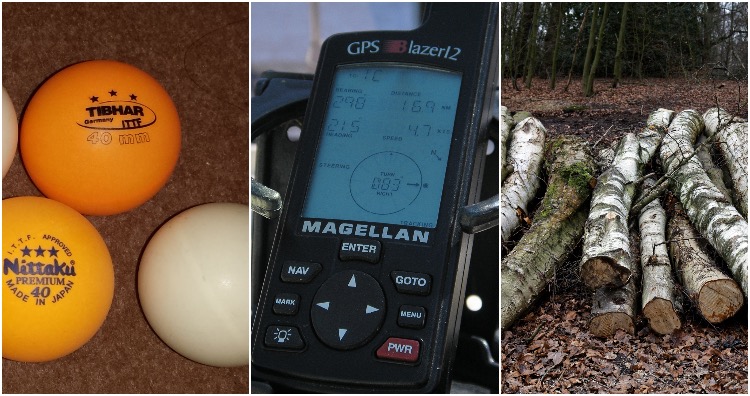


Image Source: Wikimedia Commons, Wikimedia Commons, Wikimedia Commons

Thomas Hobbes rightly said that curiosity is the lust of the mind. People were so curious to find out where the river ends up that they have conducted numerous experiments. One of the most famous experiments included the pouring of numerous ping pong balls into the pit. A phone number was etched onto each ball with a message that if found, the person should call back and would get a reward. Not a single call came to claim the reward.
Other experiments involved the throwing of GPS trackers, logs, loose change, and twigs. Local legends also suggest that people have been known to throw televisions, refrigerators, and even a car into the hole. But the probability of bringing a car to the crest of the waterfall seems highly unlikely.

Many theories have come up to explain the mystery. Some believe that there might exist an underground river. Others believe in the existence of an ancient lava tube that carries the water directly to the floor of Lake Superior. Both theories have been dismissed.


The theory for the existence of underground river was dismissed by geologists because such geological formations take place in soft rock types, like limestone. The area around the Devil’s Kettle is built of much harder rock.
Moreover, the existence of a lava tube deep down the falls is unlikely because, in the hundreds of the exposed basalt beds formed by volcanic eruptions in Minnesota, no lava tubes were ever discovered.

In February 2017, the Minnesota Department of Natural Resources finally established that the disappearing water resurfaces in the stream below the waterfall.
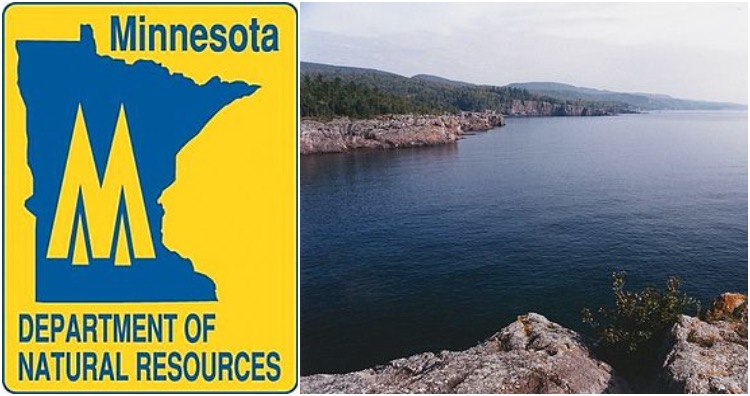


Image Source: Wikipedia, Wikipedia

Finally, in February 2017, some light was shed into the mystery behind this unique waterfall. A team of hydrologists from the Minnesota Department of Natural Resources measured the flow rate of the water above Devil’s Kettle at 123 cubic feet per second. The water was flowing at 121 cubic feet per second hundreds of feet below the waterfall.
According to hydrologist Jeff Green, these rates are essentially the same and therefore, there is no loss of water below the kettle. This means that water is resurging in the stream from below.
To confirm their theory, researchers were planning to conduct a dye test wherein they would pour vegetable dye into the pit and monitor where the water resurfaces. But the researchers never came back as “there was not a significant scientific reason,” according to the park’s manager, Pete Mott.
As to the items that have disappeared when thrown into the pit, Green explains that due to the powerful recirculating currents, the items may have been disintegrated or held underwater until they resurface downstream at some time.[source: 1, 2, 3, 4]

Monday, February 19, 2018

Following Heavy Downpour, Spiders Cover a Park in Australia in Spider Webs

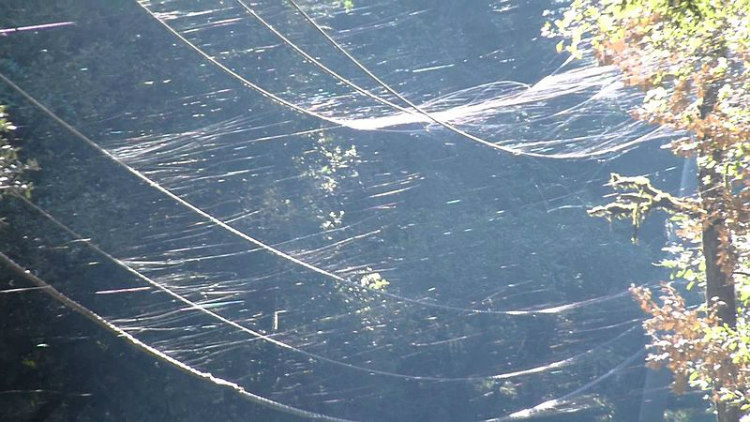
For many, spiders are a source of dread that sends chills down their spine. If seeing one spider can make one scared, imagine what seeing millions of them would be like! Over a year ago, millions of baby spiders did migrate to a park in Australia leaving the place covered in fine silk threads, a phenomenon known as “ballooning.” It has often been mistaken by UFO enthusiasts for “angel hair,” a sticky fibrous substance reported in connection with UFO sightings or manifestations of the Virgin Mary. Ballooning is also a common method for spiders to reach areas that are otherwise difficult.

In 2016, when Leslie Anne Schmidt and her partner went to a park in Australia to catch a Pokemon, they found it covered in spiderwebs. The spiders fled flooded areas following a recent heavy downpour to escape to a higher ground. 


Image Source: Leslie Schmidt

The park is located in Yinnar, a rural township in central Gippsland, Victoria, Australia. Heavy rains in that region have forced the spiders, especially juvenile wolf spiders and money spiders, to parachute themselves to safety using a technique known as “ballooning.” According to Leslie Anne Schmidt, she and her partner were trying to catch Meowth, a creature from the Pokemon game, when they went to the park and found it blanketed with a layer of spider silk.

Spiderlings often climb to the highest point they could reach and release fine silk threads that work like a parachute and carry them away in the air currents. They do this to flee from floodwater or to disperse to a new location after hatching. 


The ballooning behavior, also known as “kiting,” is mostly limited to juvenile spiders or species of spiders that are small in size. It is generally thought that spiders weighing over one milligram are unlikely to achieve liftoff, but adult females of some species weighing over 100 milligrams were observed using air movement in thermal columns for liftoffs on hot days without winds. The spiderlings use especially fine silk that scientists metaphorically call “gossamer” which they release from their spinnerets into the air forming a triangular-shaped parachute. Any updrafts of wind, the slightest of breezes, or even Earth’s static electric field on windless days provide these arachnids the liftoff they need.

Spiders use ballooning as a means of migration which enables them to reach isolated locations that are impossible to reach by land. They are known to travel as far as 1,600 kilometers in the air and for as many as 25 days.


Ballooning Spiders
Image Source: wikipedia

Ballooning spiders have been found to have traveled anywhere from a few meters to hundreds of kilometers. Many sailors have reported spiders being caught in the ship’s sails when they are over 1,600 kilometers (990 miles) from the land. They have even been detected in atmospheric samples collected from balloons at altitudes as high as five kilometers (16,000 feet) both above Earth’s surface and mid-ocean. Ballooning is considered the most common ways in which spiders invade isolated islands and mountaintops.
The spiderlings don’t always survive their trip during ballooning and mortality is high. However, they have been known to survive without food for as long as 25 days while traveling. They can land on both land and water. They use their water-repellent legs to stay alive if they land on water, fresh or salty. Some mites and caterpillars also use silk to disperse in the air.

This wasn’t the first time the spiders have gone on a mass ballooning trip. In March 2012, millions of them migrated to Australia’s Southern Tablelands covering the countryside so completely that it looked like it snowed.


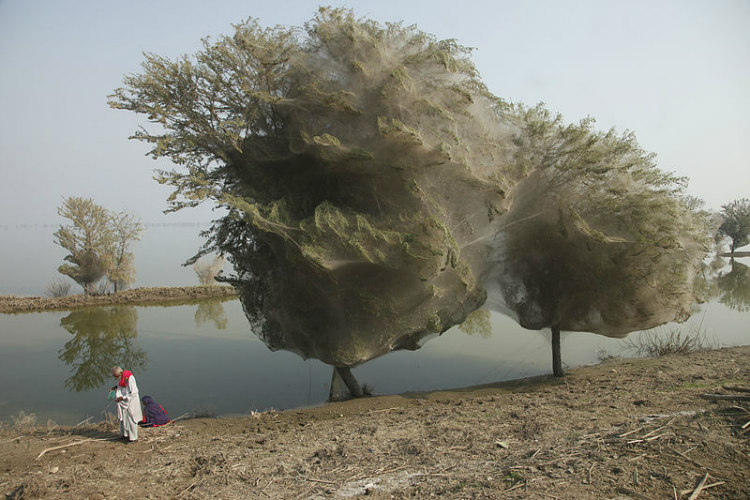
Trees Cocooned in Spider Webs in Sindh, Pakistan
Image Source: Department for International Development

In March 2012, eastern Australia faced floods considered the worst in past 160 years after a decade-long drought and bushfires. At least 13,000 people fled their homes. Following the floods, several millions of spiders migrated to the countryside of Wagga Wagga, New South Wales, Australia. Such massive ballooning events are not unique to Australia. It has been spotted elsewhere in the Northern Hemisphere, especially the United States and Britain, where according to Bennett it is a “relatively rare and random” event. Another recorded instance was in 2010 when the trees in the village of Sindh, Pakistan, were cocooned in spider webs following unprecedented monsoons in July that flooded the country’s rivers.
[sources: DailyMail, Wikipedia, NationalGeographic]

Comments system

[blogger][disqus][facebook]

Disqus Shortname

sigma2

Post Bottom Ad

Responsive Ads Here